Malta has more diveable wrecks in a small area than almost anywhere in Europe, and they come from two very different places: ships lost in wartime, and ships sunk on purpose to build reefs.
That mix is what makes the diving here unusual. In one week you can put your hands on a Royal Navy destroyer in fourteen metres of water and swim the length of an oil tanker at thirty-six. Below is the story behind each one, along with the depth and the certification you need to reach it.
Why Malta is famous for wreck diving
Two accidents of history, one geological, one military.
Malta sits in the middle of the Mediterranean, which made it one of the most fought-over naval bases in Europe through both World Wars. Ships were lost here in numbers. Then, from the 1990s onwards, the islands ran a deliberate artificial reef programme, scuttling retired tugs, ferries and patrol boats in chosen places at chosen depths.
The result is a catalogue of wrecks that a working port would never produce on its own: sitting upright, clear of nets, in water that regularly opens past 30 metres, and nearly all of them reachable from shore.
Malta’s wrecks at a glance
| Wreck | Depth | Certification | Where |
|---|---|---|---|
| HMS Maori | 14 to 16 m | Open Water | Marsamxett, Valletta |
| Tug 2 | ~20 m | Open Water | Exiles, Sliema |
| X127 | Shallow, on a slope | Open Water | Manoel Island |
| MV Rozi | 18 to 36 m | Open Water to Advanced | Cirkewwa |
| P29 | ~33 m | Advanced | Cirkewwa |
| Um El Faroud | Deck ~25 m, max 36 m | Advanced | Wied iż-Żurrieq |
| MV Karwela | ~40 m | Deep | Xatt l-Aħmar, Gozo |
| MV Cominoland | ~40 m | Deep | Xatt l-Aħmar, Gozo |
HMS Maori: a Royal Navy destroyer in fourteen metres
HMS Maori is the wreck that puts Malta on a lot of divers’ lists, and she earned it above the water rather than below it.
A Tribal-class destroyer of the Royal Navy, she took part in the final action against the Bismarck in May 1941. In February 1942, during one of the air raids on Valletta, she was hit and sank in the harbour. What remained of her was raised after the war and scuttled off St Elmo, where the bow section still lies.
She sits in around fourteen metres on sand, and that is what makes her remarkable. Not a scuttled tug or a reef project, but a warship sunk in action, shallow enough for a diver who was certified last week.
Depth 14 to 16 m · Open Water · Marsamxett, Valletta
Um El Faroud: Malta’s signature wreck
The Um El Faroud is widely regarded as Malta’s signature wreck dive and is often considered one of the best wreck dives in Europe.
Built in England in 1969, the vessel served as a Libyan oil tanker transporting fuel across the Mediterranean. In 1995, while undergoing maintenance at Malta Drydocks, a tragic gas explosion claimed the lives of nine workers, bringing the ship’s career to an end.
Rather than being scrapped, the tanker was intentionally sunk off Wied iż-Żurrieq in 1998. A powerful storm later split the wreck into two sections, creating the dramatic swim-throughs that attract advanced divers today. Resting at around 36 metres, the wreck is now covered with marine life and remains one of Malta’s most unforgettable dives.
Deck at ~25 m, maximum 36 m · Advanced Open Water · shore entry at Wied iż-Żurrieq
MV Rozi: the tug that became a reef
The MV Rozi proves that retired ships can become some of the Mediterranean’s best dive sites.
Built in 1958, the harbour tug spent decades working in Valletta’s Grand Harbour before being retired in the early 1990s. Instead of being dismantled, it became part of Malta’s artificial reef programme and was intentionally sunk at Cirkewwa.
Today, the wreck remains remarkably intact, making it easy to recognise the wheelhouse, propeller, and overall structure. Barracuda, groupers, moray eels, and octopus are frequently spotted around the wreck, making every dive slightly different.
Depth 18 to 36 m · Open Water for the superstructure, Advanced for the seabed · shore entry at Cirkewwa
P29: a Cold War patrol boat on the seabed
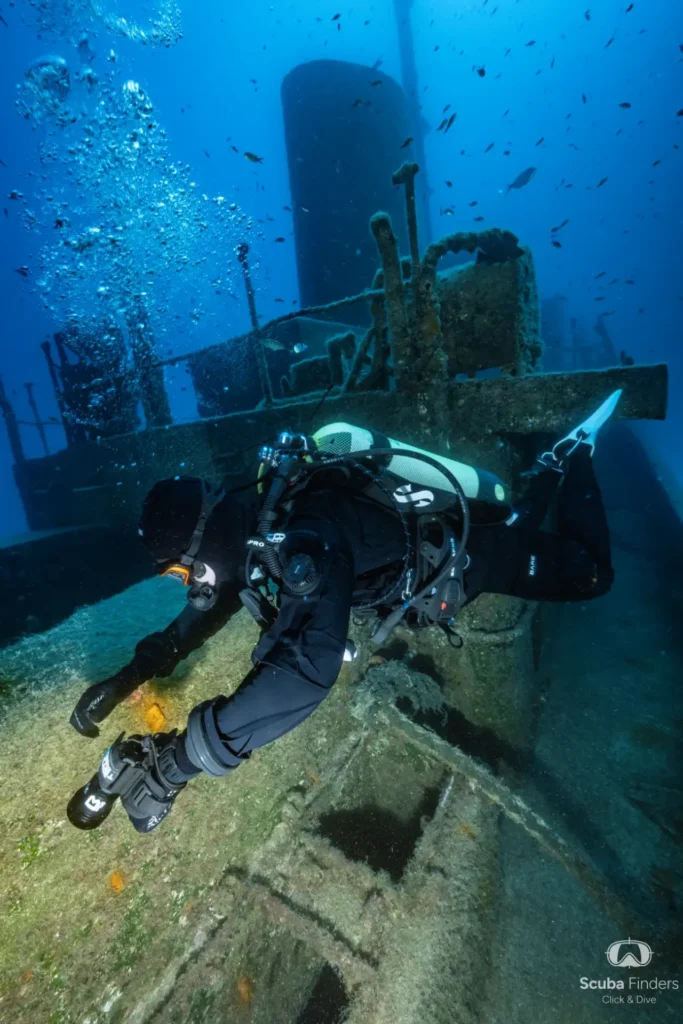
The P29 offers divers the chance to explore a genuine military vessel that has found a new purpose underwater.
Originally built in Germany during the Cold War, the ship later served with the Armed Forces of Malta before being retired. In 2007, it was intentionally sunk at Cirkewwa to expand the area’s artificial reef system.
Today, P29 rests upright on the seabed and has become one of Malta’s most popular advanced wreck dives. Its open structure and excellent visibility make it a favourite among underwater photographers.
Depth ~33 m · Advanced Open Water · shore entry at Cirkewwa
Tug 2: Malta’s newest wreck dive
Compared to Malta’s older wrecks, Tug 2 is a relatively recent addition.
The vessel worked inside Malta’s Grand Harbour before being deliberately scuttled near Exiles in 2013. A storm a few years later shifted the wreck closer to the reef, making it even more interesting to explore.
Today, Tug 2 is known for its colourful marine growth and excellent macro life. Nudibranchs, scorpionfish, and numerous small reef species have transformed the once-working tug into a thriving underwater habitat suitable for divers progressing into wreck diving.
Depth ~20 m · Open Water · shore entry at Exiles
X127: Malta’s forgotten wartime wreck
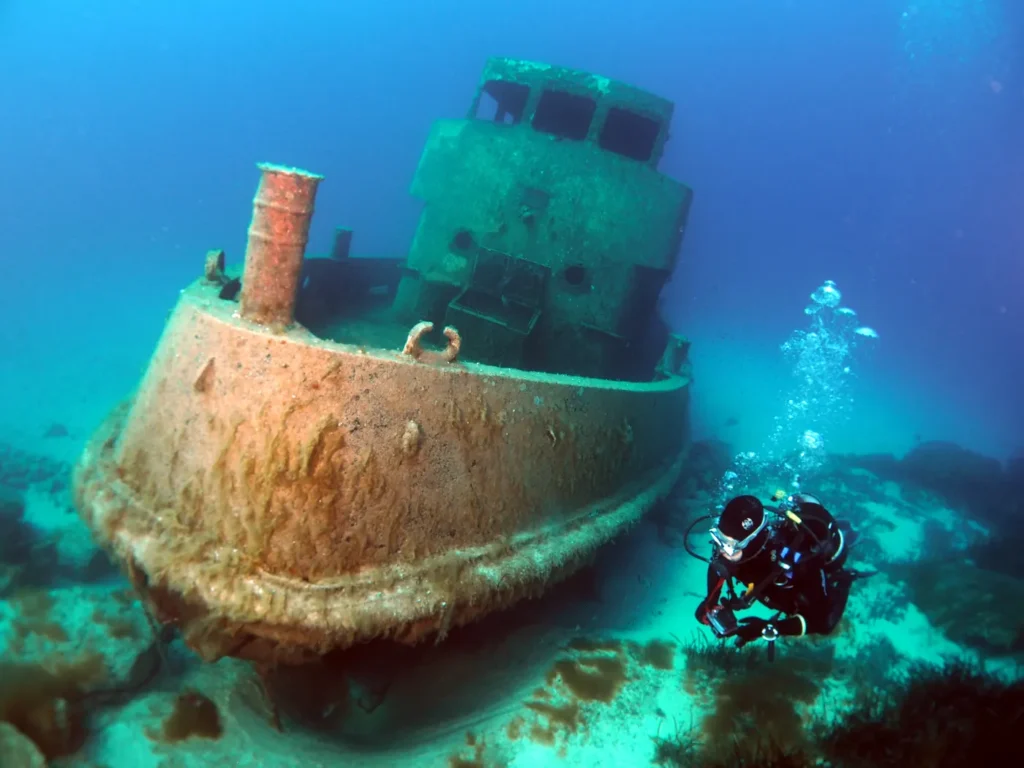
The X127 may not be Malta’s largest wreck, but it has one of the island’s most fascinating stories.
Built in 1915, the vessel served the Royal Navy during World War I before later transporting fuel and fresh water around Malta. During the intense bombing campaigns of 1942, the ship was sunk and remained unidentified for decades.
Divers knew the wreck only as “Carolita” until it was first surveyed in 2003 and confirmed as HMS X127 in 2006. Thanks to its shallow depth, X127 is an excellent introduction to historical wreck diving and a reminder of Malta’s important role during both World Wars.
Shallow, lying on a slope · Open Water · shore entry at Manoel Island
MV Karwela: Gozo’s most photographed wreck
Few underwater locations are as instantly recognisable as the staircase inside MV Karwela.
Originally built in Germany as a passenger ferry, the ship later operated tourist cruises around Malta before becoming part of Gozo’s artificial reef project in 2006.
Lying at around 40 metres, the wreck attracts advanced divers and underwater photographers from around the world. Its famous staircase has become one of the most photographed underwater scenes in Europe and is considered a highlight of diving in Gozo.
Depth ~40 m · Deep Diver · shore entry at Xatt l-Aħmar, Gozo
MV Cominoland: from minelayer to artificial reef
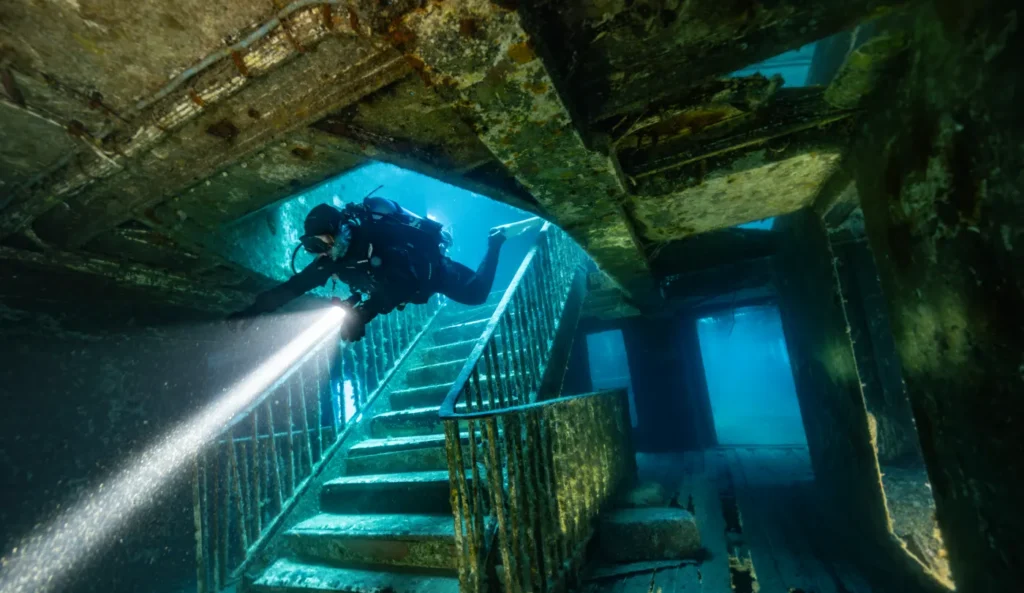
Located close to Karwela, MV Cominoland has enjoyed one of the most varied careers of any Maltese wreck.
Originally built in England in 1942 as a Royal Navy minelayer, the vessel later served as a passenger ferry connecting Valletta and Comino before operating sightseeing cruises around the islands.
When it was intentionally sunk in 2006, divers gained another outstanding wreck to explore. Before the sinking, its paint was removed as part of a marine growth experiment, allowing scientists to observe how quickly marine organisms colonised the structure.
Depth ~40 m · Deep Diver · shore entry at Xatt l-Aħmar, Gozo
Which wrecks can you dive at your level?
Your certification decides this far more than your fitness does.
With an Open Water certification you can dive HMS Maori, Tug 2 and X127 comfortably, and see a good part of the Rozi. That is two wartime wrecks and a tug on your first trip to the island.
With Advanced Open Water you add the P29 and the Um El Faroud, which is the point at which most divers say wreck diving finally makes sense to them.
For Karwela and Cominoland over in Gozo, and for going inside a wreck rather than over it, you want the Deep and Wreck Diver specialities. Both can be added while you are here, and both are worth doing in water this clear.
Dive them for yourself
Reading about a wreck and hanging above one are different experiences. Photographs never get the scale of it.
If you already dive, our guided dives run to these sites all year and our instructors have been down them hundreds of times. If you want to go inside them properly, the Wreck Diver speciality teaches the lines, the lights and the discipline that makes penetration safe. And if you have never dived at all, the Try Dive + Wreck puts a wreck on your very first dive.