Two options come up as soon as you start looking, and there is a third that almost nobody mentions.
A Try Dive puts you underwater for the first time with an instructor at arm’s length the whole way. An Open Water course turns you into a certified diver who can dive with a buddy anywhere in the world. And in between sits the Scuba Diver certification, which is the right answer far more often than people realise.
Here is what each one involves, and how to work out which is yours.
Try Dive, Scuba Diver or Open Water: the short version
| Try Dive | Scuba Diver | Open Water | |
|---|---|---|---|
| Experience needed | None | None | None |
| Time | Half a day | 1 day | 2 to 3 days |
| In the water | One guided dive | One full day of diving | 4 open water dives, plus pool sessions |
| Certification | No | Yes, SSI or PADI | Yes, SSI or PADI |
| Max depth | 12 m, with the instructor | 12 m | 18 m |
| Dive with | Instructor only | A professional | A buddy, anywhere |
| Price | €95 | €330 SSI · €380 PADI | €550 SSI · €600 PADI |
What a Try Dive actually involves
A Try Dive is a beginner scuba diving experience designed specifically for people with no previous diving experience. It allows you to discover what scuba diving feels like without committing to a full certification course. Under the guidance of a professional instructor, you’ll learn the basics of scuba equipment, underwater communication, and safety procedures before entering the water.
The experience is designed to be simple, safe, and enjoyable. You don’t need any previous certification, and you don’t need to know anything about diving before you arrive.
Most Try Dive experiences include:
- A safety briefing
- An introduction to scuba equipment
- Basic underwater skills
- A supervised dive with an instructor
- All necessary diving equipment
For many people, a Try Dive is their first opportunity to experience breathing underwater and explore the underwater world in a controlled environment.
What it is not is a certification. The day after a Try Dive you still need an instructor beside you, which is exactly the point of it.

What the Open Water course actually involves
An Open Water Course is the first level of scuba diving certification and the starting point for becoming a certified diver. Unlike a Try Dive, which focuses on introducing you to the experience, an Open Water Course teaches you the knowledge and practical skills required to dive safely and confidently.
During the course, you’ll learn:
- How scuba equipment works
- Diving safety procedures
- Underwater communication
- Buoyancy control
- Dive planning
- Emergency skills
- Responsible diving practices
Once completed, you’ll receive an internationally recognised certification from SSI or PADI, allowing you to dive up to 18 metres deep anywhere in the world.
An Open Water certification is often considered the passport to the underwater world, opening the door to dive trips, advanced courses, and countless underwater adventures.
If you want the day-by-day version, we have written about how the two or three days are split up.
The option in between: Scuba Diver
If your trip is short but you want to fly home with a certification, this is the one nobody tells you about.
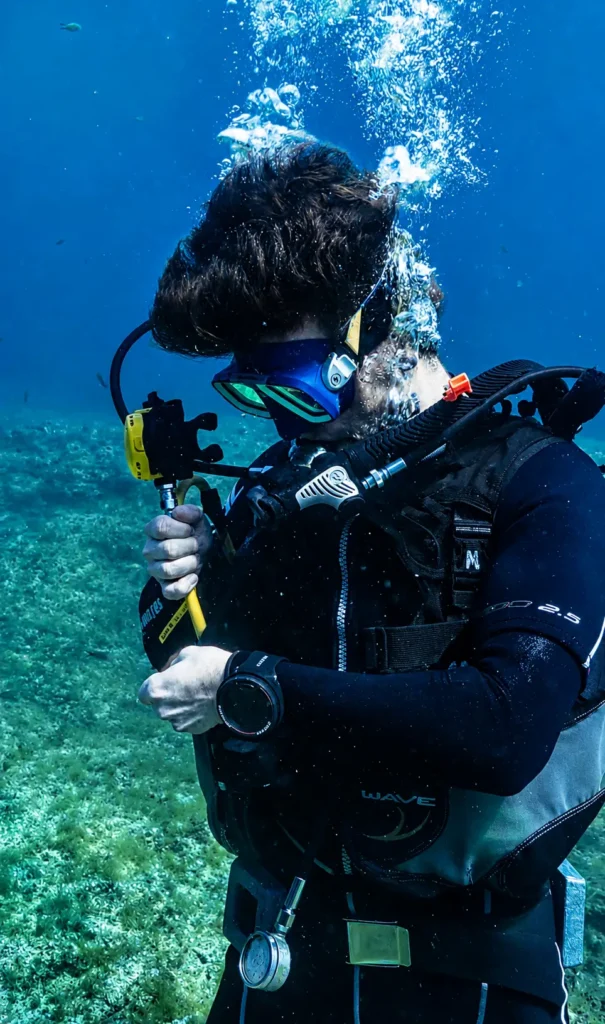
Scuba Diver is a full, internationally recognised certification and it takes a single day. It qualifies you to dive with a professional rather than with a buddy, which for most holiday divers is how they were going to dive anyway. And it carries forward: when you have more time, you upgrade to the full Open Water certification without starting from the beginning.
For a five-day holiday with three days already committed to other things, it is usually the best value on the list.

So which one is yours?
Three questions settle it.
How much time have you got? Half a day is a Try Dive. One day is Scuba Diver. Two or three days is Open Water.
How sure are you? If you have never breathed underwater and you genuinely do not know whether you will like it, start with the Try Dive. Nobody has ever regretted spending an afternoon finding out.
What do you want afterwards? If you already picture yourself diving on future holidays, or with friends who dive, go straight to Open Water. Paying for a Try Dive and then a full course afterwards costs more than the course on its own.
What if the Try Dive leaves you wanting more?
That is the usual outcome, and there is a clean route for it.
Most people who do a Try Dive are asking about the course before they have finished drying off. The Try Dive itself is not a certification and does not count towards one, but the Scuba Diver does: it covers roughly half the Open Water syllabus, so certify at that level now and you complete the rest later, here or anywhere in the world, without repeating a single session.
Start wherever suits you
Every certified diver on the planet started with one dive.
Book a Try Dive if you want to find out how it feels. Take the Scuba Diver certification if you have a day to spare. Take the Open Water course if you want the card that works everywhere, for life. All three run every day of the year from our centers in St Julian’s and St Paul’s Bay, in groups small enough that your instructor knows your name.