Two to three days. That is the honest answer for almost everyone, and it holds whether you learn in Malta, Mexico or Thailand, because the standards are the same everywhere.
What changes is how those days are arranged, how much you get done before you arrive, and what happens if the sea has other plans. Here is the whole picture, day by day.
What the two to three days look like
| When | What you do | Where |
|---|---|---|
| Before you arrive | eLearning theory, at your own pace | At home |
| Day 1 | Theory review, kit set-up, core skills | Confined water |
| Day 2 | Remaining skills and the first two open water dives | Sheltered bay |
| Day 3 | Final two dives, down to 18 metres | Open water |
The order shifts with the conditions and with how many people are on the course, but the sequence never does: theory, then skills in shallow water, then four dives in the sea. Nobody goes deep before the skills are automatic.
Start the theory before you fly
The biggest lever on how long the course takes is the theory, and you can have it finished before you land.
Both SSI and PADI run their knowledge development online: what pressure does to air and to your body, how to read a dive computer, how to plan a dive and how to stay inside safe limits. It takes a handful of evenings on the sofa, and it means your first morning here goes into the water instead of into a classroom.
Arrive with the eLearning done and two days is usually enough. Arrive with none of it done and plan for three.
Skills in confined water
Before anything happens in the sea, everything happens in shallow water.
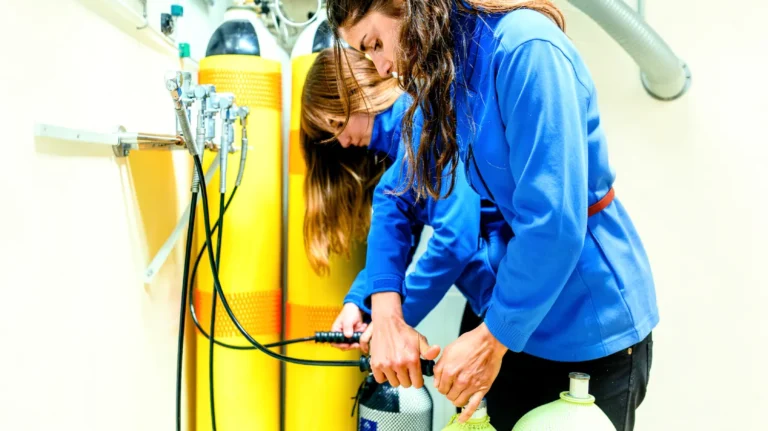
Standing somewhere you can put your feet down, you learn to assemble and check the kit, breathe from the regulator, clear a flooded mask, recover a regulator you have let go of, hold your buoyancy and ascend at a safe rate. You repeat each one until it stops needing any thought.
For most people this is the session where diving stops being an idea. You take your first breath underwater, and a few minutes later you have stopped noticing that you are breathing underwater at all.

Your four open water dives
Four dives in the sea, usually spread across two days.
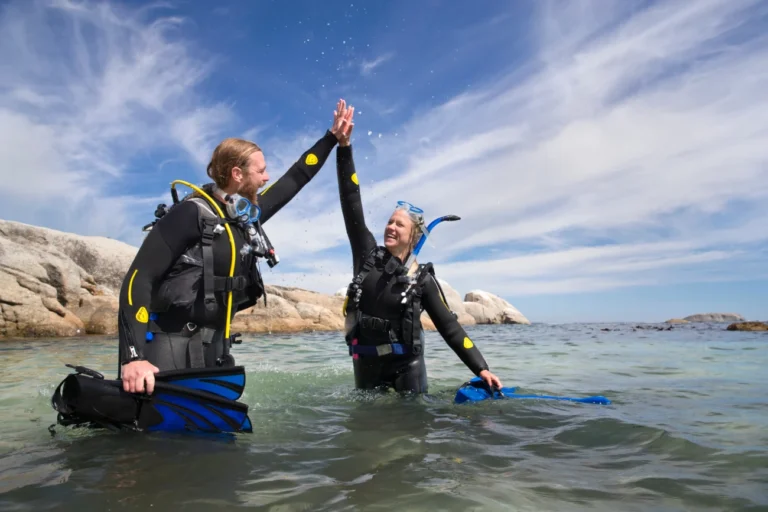
The first pair stay shallow and repeat the skills you already know, this time with no bottom to stand on. The second pair go deeper, down to the 18 metres your certification will allow, and by then most of the dive is simply diving: following a heading, watching your air, looking at whatever the site has to show you.
In Malta those dives happen in water that regularly clears past 30 metres, from entries sheltered enough that a first descent feels calm. If you want to see where you are likely to end up, our dive sites map them all out.

How many dives do you need, and how deep can you go?
Four open water dives, and 18 metres.
Those two numbers come from the certification standards rather than from the center, and they are the same with SSI and PADI. What the card gives you is the right to dive with a buddy, anywhere in the world, to 18 metres, and it never expires.
When you want more than that, the next step is Advanced Open Water, which takes you to 30 metres and brings in specialities like deep and wreck diving.
Can you do it faster?
Not really. Two days is already the compressed version, and it only works with the eLearning finished before you arrive.
With the eLearning behind you and a settled forecast, a confident student can get through the confined water session and four open water dives in two days. Squeeze it any further and what gets cut is repetition, and repetition is what makes a skill stick. A diver who was hurried through buoyancy spends the next twenty dives fighting it.
If your holiday really is too short, the better answer is not a rushed Open Water. It is the Scuba Diver certification: a real certification in a single day, and you upgrade to full Open Water later, here or anywhere in the world.
What happens if the weather turns?
Malta rarely stops diving. It moves.
When the wind swings, the sites on one side of the island go flat while the other side picks up. Because we dive every day of the year and know which entries stay sheltered in which conditions, a poor forecast usually means a change of site rather than a lost day.
It is still worth leaving a spare day at the end if your dates allow it. Not because you are likely to need it, but because finishing on day two and spending day three diving for the pure pleasure of it makes for a far better holiday than finishing on the last afternoon.
Ready to become a certified diver?
Two or three days is a small slice of a holiday for something you keep for the rest of your life.
The Open Water course runs every day of the year, in small groups, from our centers in St Julian’s and St Paul’s Bay. Send us your dates and we will tell you exactly how the days will fall.